


When feeding gets tricky.
Start with what you’re seeing. Most bottle problems have a short list of causes, and the first fix is usually the simplest one.
Every answer here is checked by an International Board Certified Lactation Consultant, the clinical credential for infant feeding. Where our IBCLC’s guidance differs from a published source, the answer says so.
Step 1: Find it by what you see
What’s happening?
- Gulping, coughing, milk spilling
- Flow may be too fast. Try one step slower
- Slow, sleepy, chewing the nipple
- Check the collar first, then the flow. The four flows
- Suddenly refusing the bottle
- Six things to try, in order. Below
- Gassy after feeds
- Some gas is normal. Here’s what helps. Below
- Milk leaking at the collar
- Usually assembly. Below
- Spitting up
- Spit-up or vomit, and when to call. Months 1–3
- Crying for hours
- What colic is, and isn’t. Months 1–3
- Distracted, or biting the nipple
- Common from about 3 months. Months 3–6
- Choking during feeds, often
- Not expected. Get it checked. Feeding safety
Step 2: Refusing the bottle
Took it yesterday. Won’t today.
Start with the basics, one at a time.
- Is milk flowing?Check the nipple isn’t blocked and the collar isn’t screwed on too tight.
- Good mood, good positionOffer when your baby is calm, comfortable and well supported.
- Try another flowToo fast or too slow can both put a baby off.
- Try another temperatureCold, room temperature or warm.
- Aim for the roof of the mouthPoint the nipple up toward the palate.
- Change the sceneA different time of day, a different room.
Still refusing after all that? Call your pediatrician or a feeding specialist.
Introduce a bottle by 6 to 8 weeks, then offer one at least once a day so your baby keeps the skill.
Pick a calm moment when your baby isn’t too hungry or too full, and start with a small amount. A breastfed baby often takes a bottle more easily from someone else, sometimes with you out of the room. Use a slow flow and hold them fairly upright. Keep tries short, stop if your baby gets upset, and try again later. It can take several days.
Source: CDC Timing: guidance from our IBCLC
Step 3: Gas
Some gas is normal. Some air is avoidable.
Some gas is normal, however a baby is fed. Swallowed air adds to it.
It’s usually not the formula: Nemours says gas, fussiness, spitting up and constipation usually aren’t the formula’s fault. How you mix matters more. The AAP points out that the more you shake, the more bubbles end up in the bottle. Let the bottle settle for a moment after shaking. Pausing to burp during the feed helps too.
Sources: Nemours KidsHealth; AAP Guidance from our IBCLC
Step 4: Leaks
Leaking at the collar? Check the assembly.
Stop and reassemble. It’s almost always the fit.
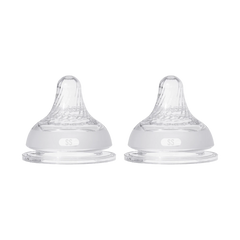
The nipple should sit flat in the collar, the collar should be aligned, and every part should be undamaged. Screw the collar on snug, not tight: over-tightening warps the seal. Check the nipple for tears or wear and replace any damaged part. How to put it together
Something else going on with a Ronini part? Email hi@ronini.com. A person answers.
The short version.
When feeding gets tricky in 4 lines.
Find it by what you see Start with what you see. Gulping and coughing usually means the flow is too fast.
Refusing the bottle Took it yesterday, won’t today? Start with the basics, one at a time.
Gas Some gas is normal, however a baby is fed. Swallowed air adds to it.
Leaks Leaking at the collar? It’s almost always the fit: stop and reassemble.