

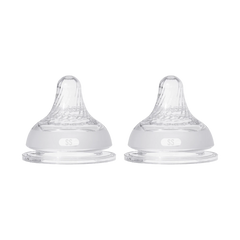

Giving a bottle.
Your baby sets the pace. You hold the bottle level and watch for the signs. Six steps, and the third one is mostly patience.
Every answer here is checked by an International Board Certified Lactation Consultant, the clinical credential for infant feeding. Where our IBCLC’s guidance differs from a published source, the answer says so.
Step 1: Paced feeding, step by step
Your baby sets the speed.
A way of bottle feeding that lets your baby set the pace. Yes, it works with breast milk or formula.
Hold the bottle level so milk only flows when your baby sucks, let them take breaks when they want, and stop when they show they’re full.
- Start before cryingFeed at the early signs: hands to mouth, rooting, lip smacking. Crying is a late sign. Already upset? Calm them first.
- Hold them close and semi-uprightHead supported and higher than the tummy. Never flat. Always hold your baby, and never prop the bottle.
- Let them take the nippleBrush it against the upper lip. When they open wide, let them draw it in. Don’t push.
- Keep the bottle nearly levelTipped just enough to fill the nipple. Milk comes out only when your baby sucks.
- Pause when they need a breakSplayed fingers and toes, milk spilling, a stop in sucking. Tip the bottle down. Burp once halfway and once at the end in the first week, then every 2–3 oz (60–90 ml).
- Stop when they’re doneClosed mouth, head turned away, relaxed hands. Even if there’s milk left.
Source: CDC Guidance from our IBCLC
There’s no set time. A bottle typically takes about 15 to 20 minutes.
Much quicker than that, or lots of gulping and coughing? The flow may be too fast. The four flows
Source: La Leche League
Step 2: Angle and position
Level bottle. Semi-upright baby.
Close to horizontal, tipped just enough that milk fills the nipple.
Semi-upright or side-lying. Never flat on their back.
The AAP says feeding a baby lying down raises the risk of choking and lets milk run into the tubes behind the ears, which can lead to ear infections. Cradle your baby’s head in the crook of your arm, upright enough to breathe and swallow comfortably. Or lay them on their side in your lap or on a pillow, a position NICUs use for bottle feeds. Either way, keep the bottle horizontal so your baby controls the flow.
Step 3: When they’re done
Follow your baby, not the bottle.
No, they don’t have to finish it.
The CDC’s signs of full: closing the mouth, turning the head away, relaxing the hands. Slowing down and dozing off count too. Stop or pause when you see them, even with milk left, and check for hunger cues before offering more.
Source: CDC Guidance from our IBCLC
The short version.
Giving a bottle in 4 lines.
Paced feeding, step by step Your baby sets the speed: hold the bottle level, let them take breaks, and stop when they show they’re full.
Angle and position Bottle close to horizontal. Baby semi-upright or side-lying, never flat.
When they’re done They don’t have to finish the bottle. Stop or pause at the signs of full.
Night feeds At 3am too: hold your baby, and never put them down with a bottle.