

Overview
Bottle nipple sizes aren’t a shared standard. Each brand has its own flow names (levels, stages, numbers, letters) and its own suggested ages. And when researchers measured nipples, they found the label doesn’t reliably tell you how fast milk comes out. [1]
Names Level 1, slow, size S, stage 1: each is one brand’s own system. Nothing lines them up, so a level 2 from one brand isn’t the same speed as another brand’s medium.
Ages Most brands print an age range on the box as a guide. Several say outright that the ages are only a suggestion.
What decides Your baby. If the swallows are steady and feeds are calm and comfortable, the flow fits, whatever the label says. [2]

Brand by brand
Here’s what each brand prints and says about its own nipples, taken from its own website on October 11, 2026. Ranges change, so check the current pack before you buy.
| Brand | Flow names | Ages the brand gives | What the brand says about changing |
|---|---|---|---|
| Dr. Brown’s | Ultra-Preemie, Preemie, Level 1, Level 2, Level 3, Level 4, Y-Cut | Preemie and Level 1: 0 months+. Level 2: 3 months+. Level 3: 6 months+. Level 4 and Y-Cut: 9 months+ | “There is no right time to change your baby’s nipple level,” and some babies use Level 1 throughout. Also suggests considering Level 2 when a baby is accepting early solid foods. [3] |
| Philips Avent (Natural Response) | First Flow, then flows 1 to 5 in the US and Canada (1 to 6 elsewhere) | None on the nipple packs | Dropped ages from nipple packs because they “seemed more like a prescription than a recommendation.” Its advice: “Let your baby’s drinking style guide you, not their age.” [4] |
| Tommee Tippee | 0 Extra Slow, 1 Slow, 2 Medium, 3 Fast, Y-cut | Extra Slow: from birth. Slow: newborns and up. Medium: 3 months and up. Fast: 6 months and up | “The ages mentioned above are only a guide.” [5] |
| Hegen | Extra Slow (0), Slow (1), Medium (2), Fast (3), Y-Cut | Extra Slow: newborns and premature babies. Slow: 1 to 3 months. Medium: 3 to 6 months. Fast: 6 months onwards | “These guidelines are approximate.” [6] |
| Munchkin Bond | Stage 1 (slow), Stage 2, Stage 3 | Stage 1: 0+ months. Stage 2: 3+ months. Stage 3: 6+ months | Flow rates “to adapt to baby’s age and feeding preferences.” [7] |
| Nanobebe | Preemie, Slow, Medium, Fast, Y-Cut | Slow: 0 to 3 months. Medium: 3 to 6 months. Fast: 6 months and up | Publishes a measured flow figure for each level on its product page. [8] |
| Pura | Slow, Medium, Fast, Y Cut | Slow: 0 to 3 months | “The age range listed for each flow rate is a suggestion.” Tells flows apart by the number of holes. [9] |
| Lansinoh (NaturalWave) | Slow, Medium, Fast | None listed on the product page | Sold by flow only. [10] |
| Evenflo Feeding | Slow, Medium, Fast | Not stated in its flow guide | “Your baby will tell you when, or if, s/he is ready to move to the next nipple flow rate.” [11] |
| Ronini | Drop, Sip, Stream, Rapid | On the box: Drop and Sip 0+ months, Stream 3+ months, Rapid 6+ months | Named by pace, slowest to fastest. Change flow by your baby’s cues, not their age. [12] |
What research found when nipples were measured
Researchers put 26 nipple types from 15 brands on a pump. The fastest flowed about 50 times faster than the slowest. Their conclusion was that a nipple’s name doesn’t give clear information about its flow, and that even nipples with the same label from one brand didn’t flow alike. [1]
A bigger follow-up tested 375 nipples used in hospitals and at home. Packaging didn’t accurately reflect flow. [13] In Australia, another team found wide differences between nipples sold as “slow” and “extra-slow.” [14]
A 2025 study noted that flow levels aren’t labeled consistently across manufacturers, and that the reason for raising flow with age usually isn’t given. [15] La Leche League International tells parents the same thing: flow rate isn’t standardized across brands. [16]

Why the age on the box is a starting point
The age on a nipple pack is a brand’s guess at where an average baby might start. It isn’t a schedule. The NHS says moving to a faster teat should be led by your baby. [17]
Nationwide Children’s Hospital goes further. A baby’s pace may not match the age on the packaging, there’s no need to move up a level based on age, and a baby may use the same level the whole time they bottle feed. [2]
If your baby also feeds at the breast, a slower nipple is closer to that pace. Nationwide Children’s says these babies may benefit from one, [2] and the NHS recommends a slow-flow teat for mixed feeding. [18]
How to compare two brands at home
- Start with the slower option. Switching brands? Begin with the new brand’s slower nipple. It’s easy to move up a step if it turns out too slow.
- Watch the first two or three feeds. Gulping, coughing or milk spilling from the mouth means the new nipple is too fast. Long, frustrated feeds with quick sucking and few swallows mean it may be too slow.
- Keep everything else the same. Same position, same milk, same time of day. Then the nipple is the only thing that changed.
- Match the feeling, not the number. If daycare uses a different brand, tell them how feeds go at home (how long, how many pauses) and ask them to watch for the same signs.
Where Ronini’s flows sit
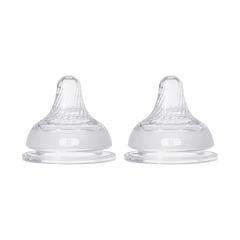
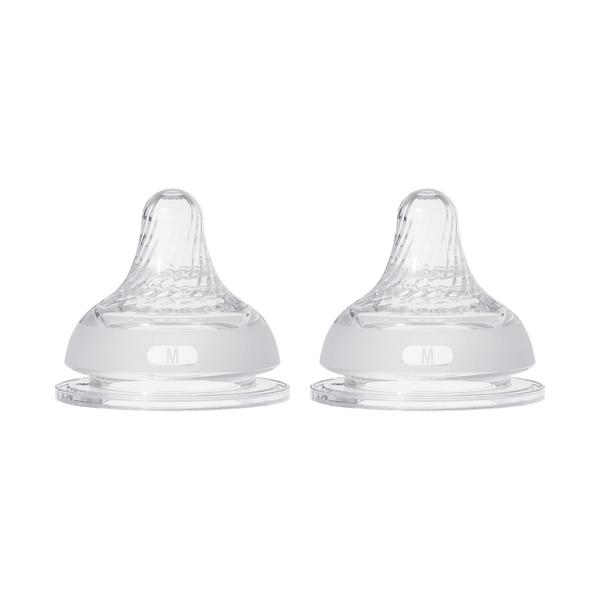
We name our four flows by pace, because pace is what you’re actually choosing. Drop is our slowest, then Sip, then Stream, and Rapid is the fastest.
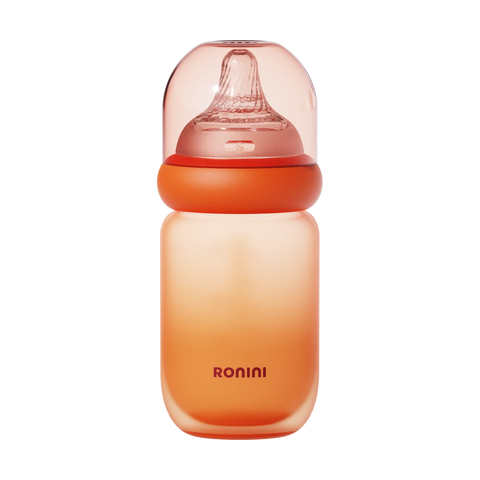
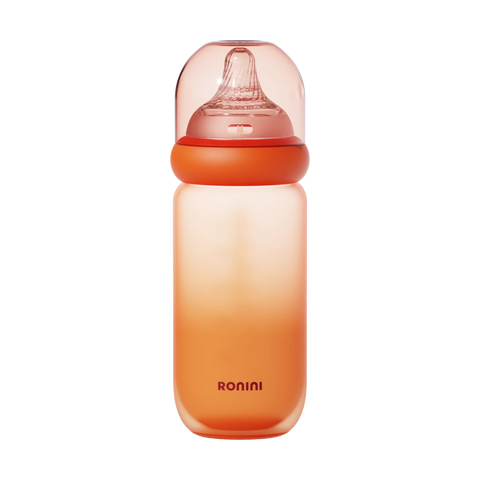
Sip comes on the 5 oz (160 ml) bottle and Stream on the 8 oz (240 ml) bottle, and all four fit both sizes. Like every brand in the table, we print an age on the box as a place to start.
Our names can’t tell you how a Ronini nipple compares with another brand’s either. Watch the first few feeds.
Accessories
Food-grade silicone nipples in four flows named by pace: Drop, Sip, Stream and Rapid. Two nipples per pack. All four flows fit both Ronini...
$10
Shop nowDisclosure This guide is published by Ronini, and Ronini nipples are our product. Other brands are included to make the comparison useful. Each brand row comes from that brand’s own website, checked on October 11, 2026, and is not a measurement by Ronini. Ranges and wording can change.
Frequently asked questions
What is a level 1 nipple?
The slow or newborn flow, in brands that number their nipples. Dr. Brown’s Level 1, for example, is marked 0 months+. Other brands call a similar flow slow, size S, stage 1 or flow 1, but the speeds don’t match across brands.
When should I move to a level 2 nipple?
When your baby shows the current flow is too slow (longer feeds, quick sucking with few swallows, fussing during feeds) and checking the nipple and assembly doesn’t fix it. Age alone isn’t a reason to move up.
Is a slow flow from one brand the same as another’s?
No. Researchers have measured large differences between brands, and even between same-label nipples from one brand. Treat each brand as its own scale.
What is the slowest nipple flow?
Each brand’s preemie or extra-slow nipple. Some are meant for premature babies or for use under medical advice, and others are sold for first feeds. Nationwide Children’s Hospital says most babies born around their due date can use a newborn flow, such as level 1 or slow flow.
Can I use one brand’s nipple on another brand’s bottle?
Usually not. Nipples are made to seal with their own collar and bottle, and a poor fit can leak or change the flow. Stick with nipples made for your bottle.
Why does the same nipple seem faster after a few weeks?
Silicone wears with use, heat and cleaning, and a worn nipple can feed differently. Check nipples before every feed. Replace any that look thin, sticky, swollen or torn.
References
Sources & references
- [1] Pados BF and colleagues. Milk Flow Rates from Bottle Nipples Used After Hospital Discharge. MCN, The American Journal of Maternal/Child Nursing. 2016.
- [2] Nationwide Children’s Hospital. Choosing a Bottle Flow Rate (Helping Hands HH-IV-244). 2021.
- [3] Dr. Brown’s. Nipple Level Guide. Checked October 11, 2026.
- [4] Philips Avent. Why is there no age indication on the Natural Response nipple packs? Checked October 11, 2026.
- [5] Tommee Tippee. How to choose the right nipple flow for your baby. Checked October 11, 2026.
- [6] Hegen. Baby bottle teat size guide. Checked October 11, 2026.
- [7] Munchkin. Bond Bottle Nipples. Checked October 11, 2026.
- [8] Nanobebe. Silicone Baby Bottle Nipples. Checked October 11, 2026.
- [9] Pura. Which flow rate for my baby? Checked October 11, 2026.
- [10] Lansinoh. NaturalWave Nipples. Checked October 11, 2026.
- [11] Evenflo Feeding. When to move to the next flow of nipple. 2019, checked October 11, 2026.
- [12] Ronini. Feeding 101: nipple flows.
- [13] Pados BF, Park J, Dodrill P. Know the Flow: Milk Flow Rates From Bottle Nipples Used in the Hospital and After Discharge. Advances in Neonatal Care. 2019.
- [14] Marshall and colleagues. Assessing the flow rate of different bottles and teats for neonates with feeding difficulties: an Australian context. Journal of Neonatal Nursing. 2021.
- [15] Crandall and colleagues. Infant feeding behavior development to 12 months with typical and slower-flow artificial nipples. Appetite. 2025.
- [16] La Leche League International. Bottles and Other Tools. March 2025.
- [17] NHS Best Start in Life. Things you need for formula feeding. December 2025.
- [18] NHS Best Start in Life. Introduction to mixed feeding. February 2026.
General information, not medical advice. Your pediatrician knows your baby best. Last reviewed October 11, 2026.
Feeding notes from Ronini
Practical feeding tips, new products, and news from us.
Sign up for Ronini emails. Unsubscribe anytime. Read our Privacy Policy.
Further reading
Explore The Ronini Journal Glass Bottles
 Glass Bottles
 Bottle Care


